The Portuguese Settlement: Keeping 500-Year-Old Christmas Traditions Alive in Malacca
If you happen to be traveling through Southeast Asia in December, specifically along the southwestern coast of Malaysia, you might expect humid tropical nights, bustling night markets, and the scent of satay grilling over charcoal. But if you navigate toward the coast of Melaka (Malacca), you will find something entirely unexpected: a winter wonderland of lights, nativity scenes, and a community singing hymns that date back five centuries.
Table of Contents
ToggleThis is the Portuguese settlement Malacca, a vibrant enclave in Ujong Pasir where the descendants of 16th-century Portuguese conquerors and local families have forged a unique identity. Known locally as the Kristang community, they are the living custodians of a heritage that fuses East and West in a way found nowhere else on Earth.
For travelers from the United States, Singapore, or Australia seeking cultural depth beyond the standard tourist trail, a visit here offers a rare glimpse into a distinct subculture. This article explores the history, the food, and the spirited resilience of the Portuguese settlement Malacca, particularly during its most famous season: Christmas.
Frequently Asked Questions (FAQ)
1. Where is the best place to celebrate Christmas in Malaysia?
For a truly unique experience, the Portuguese settlement Melaka Christmas celebration is widely considered the best place. Unlike the commercial mall decorations in Kuala Lumpur, the Portuguese settlement Malacca offers a warm, community-driven atmosphere featuring elaborate home light displays, open house traditions, and midnight mass by the seaside, attracting visitors from all over the world.
2. What did the Portuguese do in Malacca?
The Portuguese arrived in 1511 to conquer Malacca and control the lucrative spice trade of the East. Beyond building fortifications like A Famosa, their soldiers intermarried with local women, creating the Kristang community. Today, their legacy survives not in political power, but through the culture, religion, and language preserved in the Malacca Portuguese village.
3. What's the best time to visit Jonker Street?
The best time to visit Jonker Street is Friday through Sunday evening, from 6:00 PM onwards, when the famous Night Market is in full swing. Since Jonker Street is only a 15-minute drive from the Portuguese settlement Malacca, many travelers plan their itinerary to hit the night market for street food before heading to the settlement for dinner and light-viewing.
4. Who are the Kristang people in Malaysia?
The Kristang community are Malaysians of mixed Portuguese and Asian (usually Malay or Indian) ancestry. Often referred to as “Eurasians,” they are devout Roman Catholics and speak a unique Creole language called Papia Kristang. The heart of this community is located in the Malacca Portuguese village (Ujong Pasir), where they maintain 500-year-old traditions.
5. What is Portuguese culture famous for?
In the context of Malacca, Portuguese culture is famous for its lively festivals like San Pedro (Fiesta San Pedro) and its fiery cuisine. Visitors flock here specifically to find the best Portuguese food Melaka has to offer, such as the signature Devil’s Curry (Curry Debal) and spicy grilled fish, which blend European stewing techniques with local Malay spices.
A Legacy Carved in Stone and Spice
To understand the Portuguese settlement Malacca today, we must look back to 1511. When Alfonso de Albuquerque conquered Malacca, seeking control of the spice trade, he didn’t just bring cannons; he encouraged his soldiers to marry local women. This policy created a new mestizo community—the Kristang.
While the Portuguese rule ended in 1641 with the arrival of the Dutch, and later the British, the people remained. They held onto their Catholic faith and their unique creole language, Papia Kristang. However, the Portuguese settlement Malacca as we know it today was only established in the 1930s.
Before this, the families were scattered. Two Catholic priests, Father Jules Pierre François and Father Alvaro Martins Coroado, petitioned the British Resident Councillor to set aside land for the scattered community. Their goal was to preserve the culture and bring the people together. The result was the Portuguese settlement Malacca, a dedicated village that has since become the heart of the Eurasian identity in Malaysia.
The Struggle for Cultural Survival
Living in the Portuguese settlement Malacca hasn’t always been easy. As a minority within a minority, the residents have had to fight to keep their traditions from fading. The Malacca Portuguese village is more than just a tourist attraction; it is a residential neighborhood where land reclamation projects and modernization constantly threaten the seafront lifestyle that the community traditionally relied upon.
Despite these challenges, the spirit of the Portuguese settlement Malacca remains unbroken. It is a place where neighbors are family, doors are left open, and history is recounted not in textbooks, but in songs and recipes passed down through generations.
The Kristang Community: A Unique Identity
The soul of the settlement is the Kristang community. The term “Kristang” is derived from “Christian,” emphasizing the defining characteristic of their identity: Roman Catholicism.
If you walk through the Portuguese settlement Malacca on a Sunday morning, the streets are quiet because almost everyone is at mass. But by afternoon, the verandas are full. You’ll hear a language that sounds like a melodic mix of old Portuguese and Malay. This is Papia Kristang. While it is classified as a critically endangered language, efforts within the Portuguese settlement Malacca are being made to teach it to the younger generation.
For visitors from multicultural hubs like Singapore or Australia, the Kristang community offers a fascinating parallel to other Eurasian communities, yet with a distinct flavor. They are loud, warm, and incredibly hospitable. If you make a friend in the Portuguese settlement Malacca, you will almost certainly be invited into their home for a meal.
Papia Kristang: The Sound of History
Language is the vessel of culture. In the Portuguese settlement Malacca, hearing the elders speak is like listening to a time capsule. Words like Bong Dia (Good Morning) or Mutu Merseh (Thank You) echo the speech of 16th-century sailors, adapted to the rhythm of the Malay archipelago.
Christmas in the Tropics: A Spectacle of Light
While the Portuguese settlement Malacca is active year-round, December is when it truly transforms. For many travelers, the Portuguese settlement Melaka Christmas celebration is a bucket-list event.
Beginning in early December, the residents of the Portuguese settlement Malacca engage in a friendly but fierce competition to decorate their homes. We aren’t talking about a simple string of lights. We are talking about elaborate facades, rooftop Santas, and LED displays that rival the decorations on Orchard Road in Singapore or Fifth Avenue in New York, but with a distinctively home-spun charm.
The Lighting Ceremony
The “light-up” usually happens in the first week of December. The main road leading into the Portuguese settlement Malacca becomes a gridlock of cars and pedestrians. Visitors from Kuala Lumpur and Singapore flock here to see the spectacle.
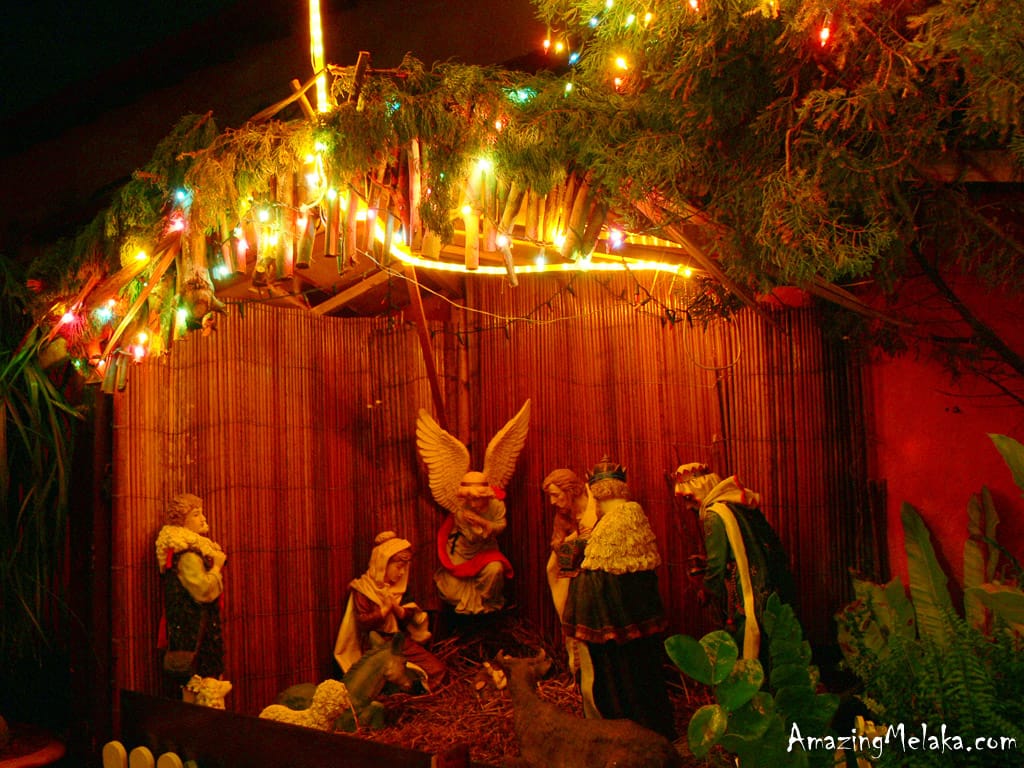
For the Kristang community, however, this is deeply spiritual. The lights represent the light of Christ. Amidst the flashing LEDs, you will always find a Presepio (Nativity scene) in the Portuguese settlement Malacca homes, often featuring figurines that have been in the family for decades.
Christmas Eve: The Heart of the Celebration
If you are planning a Portuguese settlement Melaka Christmas trip, aim to be there on Christmas Eve. The atmosphere is electric.
- Midnight Mass: The entire Portuguese settlement Malacca empties out as residents head to St. Peter’s Church or the settlement’s own chapel.
- The Homecoming: After mass, the streets fill up again. This is the time for “Open House.”
- Supper: Families in the Portuguese settlement Malacca gather for a late-night feast.
The Portuguese settlement Melaka Christmas experience is unique because it is communal. In Western countries, Christmas is often a private family affair inside the home. Here, the celebration spills out onto the street.
A Culinary Journey: The Best Portuguese Food Melaka
You cannot write about this community without discussing the food. The cuisine of the Portuguese settlement Malacca is a fiery, tangy fusion that tells the story of the spice trade. It marries Portuguese stewing techniques with local ingredients like galangal, chilies, vinegar, and shrimp paste (belacan).
If you are hunting for the best Portuguese food Melaka, you must head to the “Portuguese Square” located by the seaside within the settlement. Here, a row of restaurants serves up the classics.
The Devil’s Curry (Curry Debal)
This is the signature dish. Despite the name, it has no satanic origins—it was originally “Curry de Bal” (pot curry), made from leftovers after Christmas. Today, it is a premium dish made with chicken or wild boar, flavored with vinegar, mustard seeds, and an immense amount of chili. It is spicy, sharp, and addictive. You will find the best Portuguese food Melaka experiences always center around a pot of this curry.
Grilled Fish (Ikan Bakar)
While the Portuguese settlement Malacca was founded by fishermen, the style of grilled fish here is distinct. The fish (often stingray or seabass) is slathered in a sambal paste that is distinct to the Kristang community before being wrapped in banana leaves and grilled.
Sugee Cake and Pineapple Tarts
For dessert, the Portuguese settlement Malacca is famous for Sugee Cake, a dense, buttery semolina cake that is mandatory at weddings and Christmas. Tiny, melt-in-the-mouth pineapple tarts are also a staple.
Where to Eat
When looking for the best Portuguese food Melaka, look for places like J&J Corner or Sea Terrace within the settlement. These are family-run establishments where the recipes haven’t changed in forty years. The ambiance is open-air, overlooking the Straits of Malacca, allowing you to dine with the sea breeze in your hair.
Beyond Christmas: The Festival of San Pedro
While the Portuguese settlement Melaka Christmas season is the most famous, it is not the only time the village comes alive. The Feast of San Pedro (Saint Peter), held every June, is equally significant.
Saint Peter is the patron saint of fishermen, and given the fishing roots of the Portuguese settlement Malacca, this festival is taken very seriously.
- Blessing of the Boats: The fishermen decorate their boats with flags and biblical quotes. A priest blesses them for a safe and bountiful year.
- Cultural Performances: The Malacca Portuguese village square hosts traditional dances like the Branyo and the Farapeira.
- Costumes: You will see women dressed in traditional costumes influenced by 17th-century Portuguese fashion.
If you prefer a summer trip, skipping the Portuguese settlement Melaka Christmas crowds to see San Pedro in June is a fantastic alternative for cultural immersion.
The Architecture and Layout
Walking through the Portuguese settlement Malacca, you might notice the street names: D’Albuquerque, Sequeira, Eredia. They are named after Portuguese admirals and captains. The houses, however, are a mix of modern Malaysian brick homes and older wooden structures.
The layout of the Malacca Portuguese village is designed for community. Houses are built close together. Low fences (or no fences) encourage conversation. In the Portuguese settlement Malacca, privacy is secondary to community connection.
For architecture buffs, look for the “Christ the Redeemer” statue in the central square, a miniature replica of the one in Rio de Janeiro. It stands as a symbol of the shared faith that binds the Portuguese settlement Malacca together across the globe with other Lusophone cultures.
Travel Guide: Visiting the Settlement
For our readers from the US, Australia, and Singapore planning a visit, here are the logistics for navigating the Portuguese settlement Malacca.
How to Get There
The Portuguese settlement Malacca is located in Ujong Pasir, about 3 to 4 kilometers from the main UNESCO heritage center of Jonker Street.
- By Car/Grab: It is a 10-15 minute drive from the city center, depending on traffic.
- By Bicycle: You can cycle there, but be aware that the roads are narrow.
Best Time to Visit
- For Atmosphere: Arrive at dusk (around 7:00 PM). This allows you to catch the sunset by the sea before the lights of the Portuguese settlement Malacca turn on.
- For Food: The restaurants in the Malacca Portuguese village generally open for dinner service around 6:00 PM.
Etiquette Tips
Remember that the Portuguese settlement Malacca is a residential area, not a theme park.
- Respect Privacy: While the residents are friendly, do not walk into open gates unless invited.
- Dress Modestly: While it is a coastal area, it is also a religious community.
- Tipping: Not mandatory in Malaysia, but appreciated in the family-run stalls of the Portuguese settlement Malacca.
Why Preservation Matters
In a rapidly globalizing world, places like the Portuguese settlement Malacca are rare gems. They represent a “creolization” of culture—proof that people from vastly different worlds can come together to create something new and beautiful.
For the Kristang community, the settlement is their last bastion. As younger generations move to Kuala Lumpur or Singapore for work, the population of the Portuguese settlement Malacca faces demographic challenges. Tourism, when done respectfully, provides a vital economic lifeline that encourages the younger generation to see value in their heritage.
By visiting the Portuguese settlement Malacca, eating the best Portuguese food Melaka has to offer, and sharing their stories, you are helping to keep this 500-year-old flame alive.
The Future of the Settlement
What does the future hold for the Portuguese settlement Malacca? There is hope. A resurgence of interest in Kristang heritage has led to dictionaries being published and cultural troupes performing internationally.
The Malacca Portuguese village is also adapting to modern tourism without losing its soul. Homestays are becoming available, allowing visitors to live with a Kristang community family for a few days. This offers a deeper immersion than a quick dinner stop.
If you visit during a Portuguese settlement Melaka Christmas, you will see children running around with sparklers, speaking a mix of English, Malay, and Kristang. In their laughter, you hear the future of the Portuguese settlement Malacca—a future that honors the past while embracing the new.
Conclusion
The Portuguese settlement Malacca is more than just a cluster of houses with Christmas lights. It is a living, breathing monument to history. It is a testament to the endurance of the Kristang community, who have weathered empires and changing tides to maintain their identity.
Whether you are there to hunt down the best Portuguese food Melaka can serve, to witness the dazzling Portuguese settlement Melaka Christmas displays, or simply to watch the sun set over the Straits of Malacca, you will leave with a sense of warmth. The Malacca Portuguese village reminds us that traditions are not just about rituals; they are about people, memory, and the enduring power of community.
So, pack your bags. The lights are on, the curry is bubbling, and the people of the Portuguese settlement Malacca are waiting to say Bong Vindu (Welcome).
Explore the Foundations of Malaysia
To dive deeper into the events and figures that shaped our nation, this page connects to detailed guides and historical facts about Malaysia’s journey:
- The History of Malacca
- Merdeka Day: The Story
- Tunku Abdul Rahman: The Inspiring Father
- The Portuguese Settlement: Keeping 500-Year-Old Christmas Traditions
- The Headhunters of Borneo
- The Legend of Hang Tuah
- The Legend of Mahsuri
- Malaysia Traditional Outfit and Culture
- The Story of Puteri Gunung Ledang