Into the Jungle: The Orang Asli & The Deadly Art of Blowpipe Hunting
The rainforests of Peninsular Malaysia are some of the oldest ecosystems on Earth, dating back over 130 million years. To the untrained eye of a visitor from New York, Sydney, or Singapore, the jungle is a chaotic wall of green—a cacophony of cicadas, unrecognizable vegetation, and humidity that clings to the skin. But to the Orang Asli, the indigenous people of this land, the forest is not chaos; it is a supermarket, a pharmacy, and a spiritual home.
Table of Contents
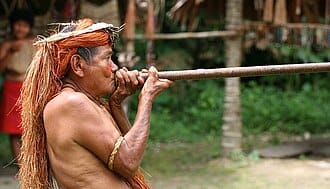
ToggleDeep within the canopy, a silence falls that is louder than the insect hum. A figure stands motionless, camouflaged by shadows. In his hands, he holds a slender bamboo tube, roughly two meters long. He raises it, inhaling deeply, his chest expanding like a bellow. With a sharp, explosive exhalation, a tiny dart tipped with lethal poison slices through the air. Thirty meters away, a squirrel drops from a branch, instantly paralyzed.
This is not sport; this is survival. This is the ancient art of the sumpit orang asli, or the blowpipe—a weapon that predates the rifle by millennia and remains a symbol of engineering genius and ecological harmony.
Frequently Asked Questions (FAQ)
1. What is the difference between Orang Asli and Orang Asal?
While often used interchangeably, there is a geographical distinction. Orang Asli (“Original People”) refers specifically to the indigenous peoples of Peninsular Malaysia. In contrast, “Orang Asal” is a broader, all-encompassing term used to describe all indigenous peoples of Malaysia, including those in Peninsular Malaysia as well as the natives of Sabah and Sarawak (Borneo), such as the Iban, Kadazan-Dusun, and Penan.
2. Which Orang Asli group is known for their skills in blowpipe hunting?
While several groups use the weapon, the Senoi people (particularly the Semai and Temiar tribes) and the Negrito people (such as the Jahai and Batek) are the most renowned for their mastery of blowpipe hunting. For the Batek in Taman Negara, the sumpit orang asli remains an essential tool for daily subsistence.
3. What do the Yanomami use to make poison for their darts?
The Yanomami tribes of the Amazon Rainforest typically use Curare, a paralyzing poison derived from the vines of the Strychnos or Chondrodendron plants. This differs from the Malaysian Orang Asli, who primarily use the latex sap of the Ipoh tree (Antiaris toxicaria) to create the lethal coating for their darts.
4. What is the difference between a blowgun and a blowpipe?
There is no mechanical difference; it is largely a difference in regional terminology. “Blowgun” is the term most commonly used in North America. “Blowpipe” is the preferred term in British English and Southeast Asia. When referring to the traditional weapon in Malaysia, it is called a blowpipe or by its local Malay name, the sumpit orang asli.
5. What is life like for indigenous people today?
Life for the Orang Asli today is a complex blend of tradition and modernity. While many have moved into permanent settlements with access to electricity, schools, and smartphones, others fight to maintain their ancestral connection to the rainforest. Despite challenges like deforestation and land rights issues, cultural practices—such as learning how to make a blowpipe—are still passed down to younger generations to preserve their identity.
Who Are the Orang Asli?
To understand the weapon, one must first understand the hunter. The term Orang Asli translates literally to “Original People” in Malay. They are not a monolith but a diverse collection of 18 distinct ethnic subgroups in Peninsular Malaysia, categorized generally into the Negrito (Semang), Senoi, and Proto-Malay.
While many Orang Asli have integrated into modern life, working in cities and sending their children to national schools, distinct groups like the Batek and the Semai continue to maintain a semi-nomadic lifestyle or live in rural settlements close to the jungle’s edge. For these communities, the forest is inextricably linked to their identity.
Unlike Western hunting traditions often associated with trophies or dominance, the Orang Asli approach hunting with a philosophy of stewardship. You take only what you need. You respect the spirit of the animal. And, perhaps most importantly, you rely on skill rather than mechanical advantage. The blowpipe is the physical embodiment of this philosophy: silent, sustainable, and demanding absolute perfection from its user.
The Sumpit: An Engineering Marvel
When we think of “primitive” weapons, we often imagine crude clubs or heavy spears. The sumpit orang asli is the opposite; it is a precision instrument of high complexity.
A typical blowpipe is roughly 1.5 to 2 meters long. It is surprisingly light but incredibly sturdy. The genius lies in its construction. It is not merely a hollowed-out stick; it is usually composed of two bamboo tubes—an inner tube (the barrel) and an outer tube (the casing).
Why Two Tubes?
The inner tube, made from a specific species of long-node bamboo (often Bambusa wrayi), provides the rifling-smooth bore necessary for the dart to travel without friction. However, bamboo is organic; it warps with humidity and age. The outer casing serves as a stabilizer, protecting the delicate inner barrel and keeping the weapon straight.
The result is a weapon that is accurate up to 30 meters—a range that rivals many traditional bows, yet operates in near-total silence. In the dense undergrowth of the Malaysian rainforest, where a gunshot would scare away game for miles, the silence of the sumpit orang asli is its greatest asset.
Crafting the Silent Killer: How to Make a Blowpipe
The creation of a blowpipe is a rite of passage and a test of patience. It can take weeks to finish a single weapon. If you were to ask an elder how to make a blowpipe, they would likely tell you it begins not with tools, but with a trek.
1. Sourcing the Bamboo
The process starts deep in the jungle to find the Bambusa wrayi or Schizostachyum jaculans bamboo. The maker looks for a stalk that is perfectly straight, with long internodes. This bamboo is cured and dried over a fire, a process that hardens the wood and prevents future warping.
2. Drilling and Boring
This is the most labor-intensive phase. Traditionally, the Orang Asli did not have power drills. They used a long iron rod with a chisel tip. The maker manually bores through the nodes of the inner bamboo tube. It requires a steady hand; one slip could crack the bamboo, rendering it useless.
3. Sanding and Polishing
Once the hole is bored, it must be polished to a mirror finish. Any roughness will deflect the dart. The craftsman pulls strips of abrasive rattan or rough leaves back and forth through the bore, sometimes for days, until the interior is glass-smooth.
4. Assembly
The inner tube is inserted into the outer casing. Natural resin (dammar) or beeswax is used to seal the ends and secure the tubes together. A mouthpiece, often carved from wood or gutta-percha, is fitted to one end.
Learning how to make a blowpipe is fading knowledge. Younger generations are often drawn to the allure of smartphones and city jobs, leaving the meticulous craft to the elders. However, cultural revitalization efforts are helping to keep these skills alive.
The Damak and the Chemistry of Death
A blowpipe without its dart is just a hollow stick. The dart, or damak, is a lightweight projectile usually made from the hard midrib of a palm leaf. At the rear of the dart is a cone-shaped flight made from light pith or soft wood, sized perfectly to create an air seal within the blowpipe bore.
But the dart itself does not kill the prey. It is merely a delivery system. The lethal component is the Ipoh poison.
The Ipoh Tree (Antiaris toxicaria)
The Orang Asli are master chemists. They tap the sap of the Ipoh tree, a milky latex that contains potent cardiac glycosides. When this sap enters the bloodstream, it causes the heart muscles to contract violently and then stop.
To create the poison, the sap is boiled down into a thick, sticky paste. In some recipes, other ingredients like toad skin, scorpion venom, or snake bile are added to amplify the potency, though the Ipoh sap remains the primary active agent.
The hunter dips the tips of the darts into this black sludge and lets them dry near a fire. Great care is taken during this process; a small cut on the finger while handling the wet poison could be fatal to the maker.
The Art of Blowpipe Hunting
Blowpipe hunting is fundamentally different from hunting with a gun or a bow. It is an intimate engagement with nature.
The hunter must get close—usually within 20 to 30 meters. This requires stealth capabilities that would impress any modern special forces soldier. The Orang Asli hunter moves barefoot, feeling the ground for dry twigs that might snap. He mimics the calls of animals to draw them out or mask his own approach.
The Mechanics of the Shot
When the target—perhaps a monkey, a squirrel, or a wild boar—is sighted, the hunter raises the sumpit. The motion is slow and fluid to avoid startling the prey.
- The Stance: The feet are planted firmly.
- The Grip: The hands hold the pipe steady near the mouthpiece, while the long barrel rests on the hunter’s outstretched arm or a natural support.
- The Breath: This is the critical moment in blowpipe hunting. The hunter does not blow from the cheeks; he blows from the diaphragm. It is a sharp, percussive blast of air, similar to a cough.
Phwip.
The sound is barely audible. If the hunter misses, the animal often doesn’t even realize it was targeted, allowing for a second shot. If the dart hits, the poison takes effect within minutes. The animal grows drowsy, its muscles slacken, and it falls from the canopy. The meat remains safe to eat because the poison acts on the heart and bloodstream but is not toxic when ingested through the digestive system (provided there are no ulcers in the mouth).
A Visit to an Orang Asli Village
For travelers from the US, Australia, or Singapore, visiting an orang asli village (Kampung Orang Asli) can be a profound experience, provided it is done ethically.
In areas like Taman Negara or the Cameron Highlands, several villages welcome visitors. Here, the distinction between the modern world and tradition blurs. You might see a thatched hut with a solar panel on the roof, or a hunter checking his Facebook account before heading into the jungle.
When you visit an orang asli village, you will often see demonstrations of fire-starting using rattan friction and, of course, the blowpipe target practice.
Ethical Tourism
It is vital to approach these visits with respect.
- Ask Permission: Never take photos of people without asking.
- Support Local: Buy handicrafts directly from the villagers.
- Listen: The elders love to tell stories. Ask about the forest, the plants, and the sumpit orang asli.
- Avoid “Human Zoos”: Choose tour operators that have a partnership with the village, ensuring the community benefits financially from your visit.
Seeing a master demonstrate how to make a blowpipe or watching the young children practice their aim on hanging fruits offers a glimpse into a lineage of survival skills that humanity is slowly forgetting.
Sustainability and Conservation
The Orang Asli are the original conservationists. Their hunting methods are naturally self-limiting. A blowpipe cannot wipe out a herd. It takes one animal at a time. Furthermore, their nomadic or semi-nomadic rotational farming allows the jungle to regenerate.
However, the Orang Asli face significant threats. Deforestation for palm oil plantations and logging encroaches on their ancestral lands. When the forest shrinks, the game disappears. The Ipoh trees are cut down. The bamboo groves vanish.
Blowpipe hunting is becoming harder not because the skills are lost, but because the environment that supports it is disappearing. Preserving the culture of the Orang Asli is not just about saving a weapon type; it is about saving the rainforest itself. Their knowledge of medicinal plants and forest biodiversity is irreplaceable.
From Child’s Play to Master Hunter
The mastery of the sumpit orang asli is not a skill learned in adulthood; it is a lifelong curriculum that begins almost as soon as a child can walk. In many Orang Asli communities, you will see toddlers playing with miniature blowpipes made from reeds or smaller bamboo. They shoot small pellets of clay or soft seeds at insects and leaves.
To the outsider, it looks like a game. In reality, it is the first step of blowpipe hunting training. Through “play,” these children develop the lung capacity and the instinctive aim required for survival. By the time a boy reaches his teenage years, he is expected to craft his own weapon. This transition—from playing with a toy to understanding how to make a blowpipe capable of killing a wild boar—marks his passage into manhood.
The Spiritual Taboos of the Hunt
It is important to understand that for the Orang Asli, hunting is not a purely physical act; it is deeply spiritual. There are strict taboos (pantang-larang) that a hunter must observe.
For instance, one must never laugh at an animal. To mock a monkey or a bird is to insult the spirit of the forest, which may result in a curse or a spell of bad luck known as busung. Additionally, when preparing the sumpit orang asli and the poison, the maker often chants mantras to guide the dart true. They believe the wind, the bamboo, and the hunter must be in total alignment. If a hunter harbors anger or bad thoughts, the dart will inevitably miss.
A Global Context: Malaysia vs. The Amazon
For readers from the United States or Australia who might be familiar with indigenous cultures in South America, the Malaysian blowpipe offers a fascinating comparison. While Amazonian tribes also use blowguns, the design differs. Amazonian blowguns are often heavier and use a different type of dart flighting (cotton or kapok fibers).
In contrast, the Orang Asli use the hard, pith-cone flight mechanism, which allows for a tighter air seal and, arguably, greater muzzle velocity. This unique engineering highlights how the Orang Asli adapted perfectly to the specific flora of the Southeast Asian rainforests, utilizing materials that were uniquely available to them to create a weapon of unmatched stealth.
Conclusion: The Breath of the Forest
In a world dominated by high-velocity rifles, drones, and industrial farming, the sumpit orang asli stands as a testament to human ingenuity and harmony with nature. It represents a time when survival depended on a deep, chemical, and physical understanding of the environment.
The next time you find yourself trekking through the humid depths of the Malaysian rainforest, pause for a moment. Listen to the silence. Realize that for the Orang Asli, that silence is not empty—it is full of life, resources, and the history of a people who mastered the art of precision without scopes.
Whether you are a history buff, an outdoor enthusiast, or a curious traveler, the story of the blowpipe hunters is a reminder that sometimes, the most sophisticated technology is the one that leaves the smallest footprint.
Malaysian Communities and Lifestyles: From Rural Traditions to Modern Living
To truly know Malaysia, you must know its people. From the stilt houses of Penang’s clan jetties to the vibrant rhythm of Kuala Lumpur’s street performers, explore the unique communities and lifestyles that define the soul of the nation:
Traditional & Rural Roots
- Kampong:Malaysia’s Astounding Culture
- Village Life Activities: Kampung Hosts and Their Tourism Stories
- Why Rural Development Matters: Live and Community
- Penang’s Clan Jetties: Living on the Water
Modern Voices & Urban Life
- Street Busker Kuala Lumpur: The Hidden Art of Malaysia’s Music Scene
- Complete 2025 Guide to MM2H Malaysia: Requirements & Costs
- Malaysia’s Sports Heroes and Their Impact
- Malaysia Tourism: Awe-Inspiring Entreprenuers
- The Living Legend: Robert Kuok at 102
Cultural Identities & Unique Lifestyles
- The Orang Asli Blowpipe Hunters: Precision Without Scopes
- Bamboo Hallelujahs: The Unique Sound of Borneo’s Jungle Churches
- Street Food Stall Owners: The Stories
- Borneo Fishing: Hunting the Royal Mahseer