Thaipusam: The Science Behind the Piercings (Why Is There No Blood?)
Imagine standing amidst a sea of vibrant yellow and saffron robes. The air vibrates with the hypnotic rhythm of drums and the chanting of “Vel! Vel!” The tropical heat of Malaysia or Singapore presses against your skin, but the crowd is oblivious to the temperature. Their eyes are fixed on a devotee approaching the temple steps. He is carrying a heavy, ornate structure known as a Kavadi, but what catches your breath isn’t just the weight he bears—it is how it is attached to him.
Table of Contents
ToggleDozens of sharp metal hooks are threaded through the skin of his chest and back. A long skewer pierces his cheeks, locking his mouth in silence. Yet, as you look closer, expecting a scene of gore, you realize something defying logic: there is no blood. The devotee is not screaming in agony; he is dancing in a state of serene trance.
This is the Thaipusam festival, one of the most visually stunning and spiritually profound events in the world. For travelers from the United States, Australia, and Singapore, witnessing this festival is often a bucket-list experience that challenges their understanding of human physiology and faith.
While the spiritual meaning of Thaipusam is deeply rooted in Hindu mythology, the physical reality of the piercings begs a scientific explanation. How is it possible to pierce the skin with such intensity without shedding blood or causing traumatic injury? In this article, we will explore the history, the ritual, and the fascinating science behind the painless piercings of the Thaipusam festival.
Frequently Asked Questions (FAQ)
1. What is the story and origin behind the Thaipusam festival?
The Thaipusam festival commemorates the Hindu legend of Lord Murugan, the God of War. According to mythology, the world was being terrorized by the demon Soorapadman. To defeat him, the Goddess Parvati gave her son, Murugan, a divine spear known as the Vel. Thaipusam marks the day Murugan used this sacred Vel to vanquish the demon, symbolizing the ultimate victory of good over evil, light over darkness, and wisdom over ignorance.
2. Why do devotees get piercings during Thaipusam?
The Thaipusam piercing is a profound act of penance and devotion. Devotees pierce their skin not to inflict self-harm, but to demonstrate the power of their faith and to fulfill a vow (nazar) made to Lord Murugan. Whether it is a tongue skewer or thaipusam hooks in the back, the piercing signifies the surrender of the ego and the physical body to the deity. It is believed that enduring this “burden” cleanses the soul of past sins and expresses gratitude for prayers answered.
3. What do devotees carry during the procession?
Devotees carry a physical burden known as a Kavadi. The type of Kavadi varies based on the devotee’s vow:
- Paal Kudam: A simple metal pot filled with milk, carried on the head.
- Spiked Kavadi: A large, ornate semicircular canopy supported by a wooden or metal frame. This structure is often attached to the devotee’s body using spikes and thaipusam hooks that pierce the skin.
- Alagu Kavadi: A specialized form where the devotee pulls a heavy chariot using ropes attached to hooks in their back.
4. What is the significance of the piercing for the Kavadi bearer?
The piercing serves as a physical connection between the devotee and the divine burden they are carrying. Specifically, the Vel piercing through the tongue or cheeks prevents the devotee from speaking. This “lock of silence” forces them to focus entirely on Lord Murugan, channeling all their energy into the pilgrimage rather than worldly distractions. The back hook piercing creates a tension that, when combined with the trance state, is said to elevate the devotee’s consciousness above physical pain.
5. What are the rules and preparations for carrying a Kavadi?
Carrying a Kavadi requires immense physical and spiritual discipline. For 48 days leading up to the Thaipusam festival, the devotee must observe a strict purification period which includes:
- A strict vegetarian diet (Sattvic food).
- Complete celibacy to preserve vital energy.
- Abstinence from alcohol and smoking.
- Cold showers and sleeping on the floor (no mattress) to master comfort and the senses.
- Daily prayer and chanting to prepare the mind for the trance.
What is the Thaipusam Festival?
To understand the piercing, one must first understand the purpose. The Thaipusam festival is a Hindu celebration observed primarily by the Tamil community on the full moon of the Tamil month of Thai (usually January or February). It commemorates the occasion when Parvati gave Murugan, the Hindu god of war, a Vel (spear) so he could vanquish the evil demon Soorapadman.
Therefore, the meaning of Thaipusam is essentially the victory of good over evil, light over darkness, and wisdom over ignorance. It is a time of penance and thanksgiving. Devotees pray to Lord Murugan to overcome obstacles in their lives, and in return, they vow to carry a burden—the Kavadi—as an act of gratitude.
The Thaipusam festival is celebrated with massive grandeur in places with significant Tamil populations, most notably at the Batu Caves in Kuala Lumpur, Malaysia, and in Singapore. For many observers, the festival is a testament to the power of the mind over the body.
The Preparation: It Starts Long Before the Day
One does not simply wake up on the morning of the Thaipusam festival and decide to pierce their skin. The preparation is rigorous, functioning as a physiological and psychological primer for the intense physical stress to come.
For 48 days leading up to the Thaipusam festival, devotees observe a strict regimen of purification. This includes:
- Celibacy: Preserving vital energy.
- Sattvic Diet: A strict vegetarian diet, often limited to one simple meal a day, avoiding stimulants like alcohol and sometimes even caffeine.
- Cold Showers: To master the senses and cool the body.
- Prayer and Meditation: Constant chanting helps shift the brain’s operating frequency.
This period of abstinence alters the body’s biochemistry. By the time the Thaipusam festival arrives, the devotee is in a state of high mental focus and metabolic purity. This preparation is the first step in the “science” of the ritual; a body free of toxins and a mind honed by discipline react differently to pain stimuli than an average person’s would.
The Burden of Devotion: Understanding the Kavadi
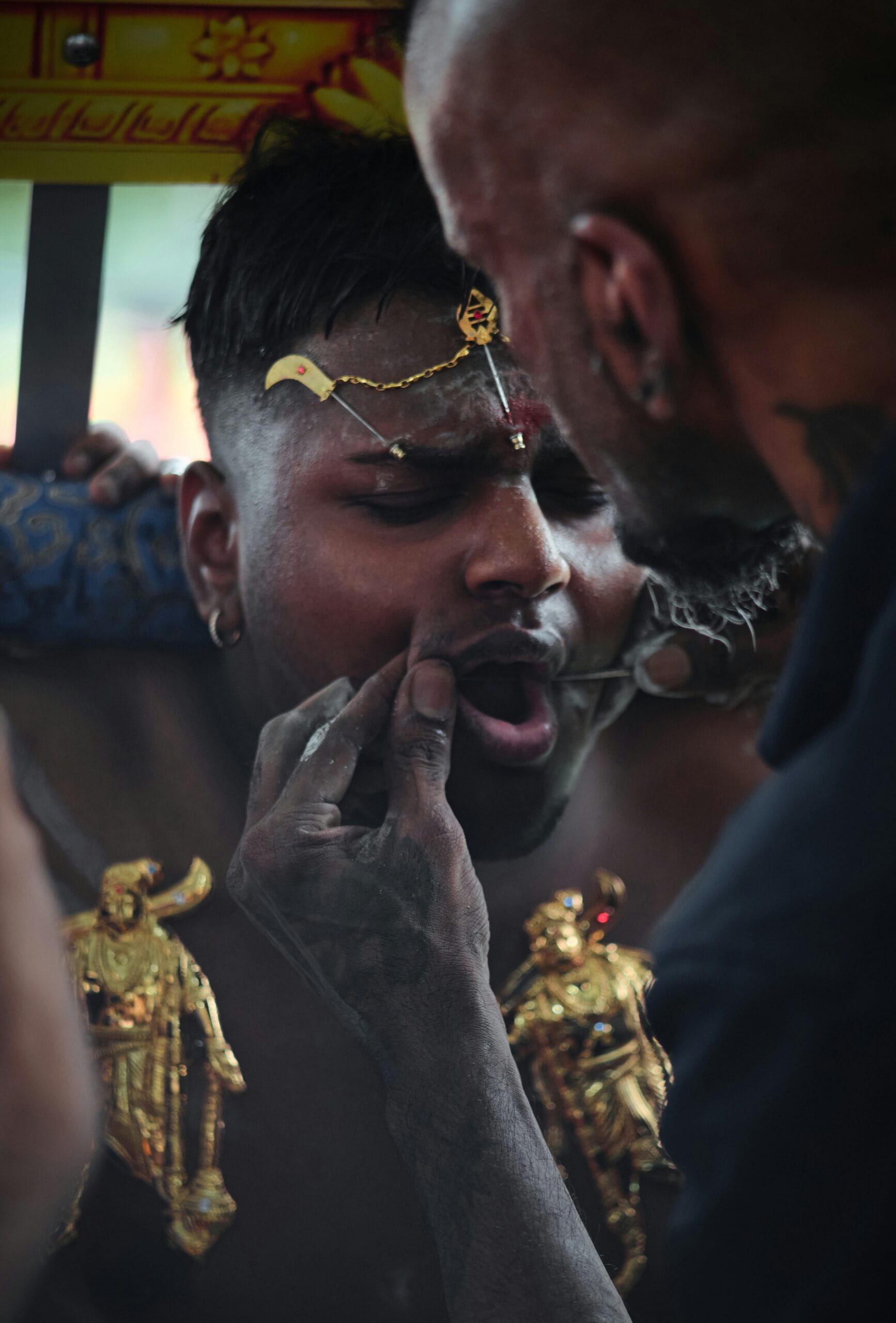
The visual centerpiece of the Thaipusam festival is the Kavadi (which literally translates to “burden”). While some devotees carry simple pots of milk (Paal Kudam), others opt for the Mortification of Flesh. This involves self-piercing with small skewers or hooks.
The Skewers and Hooks
The most common form of piercing involves a small spear, or Vel, piercing the tongue or cheeks. This particular Thaipusam piercing symbolizes the sacrifice of the gift of speech; the devotee cannot talk, forcing them to focus entirely on the deity.
Then, there are the Thaipusam hooks. These are small, sharp metal hooks threaded into the skin of the back or chest. For the larger Kavadis, which can weigh up to 80 pounds (36 kg), the structure is suspended or balanced using these hooks.
The Back Hook Piercing
Perhaps the most jarring sight for a Western tourist is the back hook piercing. In this variation, devotees may have small limes or bells hanging from hooks in their backs, or they may even pull a small chariot using ropes attached solely to these hooks. The back hook piercing places significant tension on the skin, pulling it away from the muscle, yet the skin rarely tears.
Why doesn’t the skin rip? Why don’t the wounds bleed profusely? Let’s dive into the anatomy and physics.
The Science: Why Is There Little to No Blood?
When you accidentally cut your finger in the kitchen, you bleed. So, how can a devotee at the Thaipusam festival sustain dozens of punctures without turning the temple grounds into a crime scene? The answer lies in a combination of physics, ancient technique, and human physiology.
1. The Physics of the Hooks and Ash
The Thaipusam hooks used are surgically sharp. A dull needle tears tissue, causing trauma and bleeding. A razor-sharp point, however, separates the tissue fibers rather than shredding them.
Furthermore, before the Thaipusam piercing takes place, the priests or experienced elders rub the skin with Vibhuti (Holy Ash). While this has spiritual significance, Vibhuti also acts as a powerful styptic agent. It is dry and alkaline, helping to constrict the tiny capillaries in the skin’s surface (the epidermis and dermis) upon contact. This constriction reduces blood flow to the immediate area of the puncture.
2. The “Tent” Effect and Tension
When you look at a back hook piercing carrying weight, you will notice the skin is pulled tight, forming a “tent” shape. This tension is crucial. By pulling the skin away from the underlying muscle and fascia, the hooks are seated in the collagen-rich dermal layer.
This layer is incredibly tough and elastic—think of it like leather. Because the Thaipusam hooks are curved, the weight is distributed evenly across the hook’s surface area. If the hooks were straight, they might slide out or tear. The curve locks them in place, and the tension collapses the blood vessels in that specific stretched area, further preventing bleeding.
3. The Trance State: Neurobiology of Pain
The most fascinating scientific element of the Thaipusam festival is the trance. Devotees are not “gritting their teeth” through the pain; many claim they feel no pain at all.
Scientific studies on pain perception (nociception) suggest that the “Gate Control Theory” is at play here. The intense sensory input—the drumming, the chanting, the smell of incense, the exhaustion from the walk—overloads the nervous system. The brain effectively “closes the gate” to pain signals because it is prioritizing other sensory data.
Furthermore, the rigorous fasting and the trance state trigger the release of beta-endorphins and enkephalins—the body’s natural opiates. These chemicals are far more potent than morphine. During the Thaipusam festival, a devotee in a deep trance is essentially high on their own supply of natural painkillers. This physiological state causes vasoconstriction (narrowing of blood vessels), which explains why the Thaipusam piercing sites remain dry.
The Role of Faith and Psychology
While biology explains the lack of blood, psychology explains the endurance. The meaning of Thaipusam provides a powerful placebo effect—or rather, a “belief effect.”
When the mind is wholly convinced that the deity is protecting it, the body follows suit. This is a phenomenon observed in various cultures, but it is most visible during the Thaipusam festival. The devotee surrenders their agency to Lord Murugan. This surrender reduces anxiety. Anxiety typically raises blood pressure and heart rate, which would increase bleeding. By remaining calm and in a trance, the devotee keeps their blood pressure stable, aiding the bloodless nature of the Thaipusam piercing.
Hygiene and Aftercare: Do They Scar?
Visitors from Australia or the US often worry about infection. “Is it sanitary?” is a common question.
Generally, the Thaipusam hooks and skewers are sterilized with lemon juice and holy ash, both of which have antibacterial properties. While this doesn’t meet modern hospital standards, the rate of infection is surprisingly low among devotees.
After the procession concludes and the Thaipusam festival winds down for the individual, the hooks are removed. The wounds are treated immediately with more Holy Ash and sometimes turmeric powder (a natural antibiotic). Because the Thaipusam piercing instruments are small and sharp, the wounds usually close up within hours.
Remarkably, many veteran devotees who have participated in the Thaipusam festival for decades show very little scarring. The skin heals cleanly, leaving only tiny pockmarks that fade over time.
Experiencing the Festival: A Guide for Travelers
If you are planning to travel to witness the Thaipusam festival, it is an experience unlike any other. However, it can be intense. Whether you are visiting the Sri Thendayuthapani Temple in Singapore or the iconic Batu Caves in Malaysia, here is what you need to know.
Best Locations
- Batu Caves, Malaysia: This is the epicenter. Over a million people gather here. The sight of devotees climbing the 272 steps with Kavadis is iconic.
- Singapore: The procession walks from Sri Srinivasa Perumal Temple to Sri Thendayuthapani Temple. It is more organized but equally intense.
- Palani, India: The root of the festival, offering a more traditional and rustic experience.
Etiquette for Tourists
- Dress Modestly: This is a religious event. Cover your shoulders and knees.
- Respect the Devotees: Do not block the path of a Kavadi bearer. They are carrying heavy weights and are in a trance; they cannot stop abruptly.
- Photography: Photos are generally allowed, but avoid using flash directly in the faces of those in a trance, as it can be jarring.
- Hydration: The Thaipusam festival is hot and crowded. Bring water.
Understanding what you see
When you see a back hook piercing, do not react with horror or pity. The devotee views this as a joyous sacrifice. The meaning of Thaipusam is celebration, not torture. Smile, observe, and respect the energy of the space.
The Global Appeal of Thaipusam
Why does the Thaipusam festival attract so many international visitors? Perhaps it is because, in a modern world dominated by technology and comfort, Thaipusam represents something raw and primal.
It reminds us of the untapped potential of the human mind. When we see a man suspended by Thaipusam hooks, we are forced to question our own limits. If faith can stop blood from flowing and pain from registering, what else is the human body capable of?
For the Tamil community, the Thaipusam festival is an affirmation of identity and faith. For the outsider, it is a lesson in the power of conviction.
Myths vs. Facts
There are many misconceptions regarding the Thaipusam festival. Let’s clear a few up.
- Myth: The devotees take drugs to numb the pain.
- Fact: Drug use is strictly forbidden. The trance is induced naturally through chanting, drumming, and fasting.
- Myth: The Thaipusam piercing causes permanent damage.
- Fact: The piercings avoid major nerves and arteries. Devotees recover fully within days.
- Myth: Everyone must do a piercing.
- Fact: Piercing is voluntary. Many devotees simply carry milk pots or shave their heads.
- Myth: The back hook piercing is just for show.
- Fact: While it is visually spectacular, it is a deep vow (nazar) usually taken to save a loved one from illness or to thank the deity for a miracle.
Conclusion
The Thaipusam festival serves as a stunning intersection of culture, spirituality, and biology. It challenges our Western perceptions of pain and anatomy. The sight of a Thaipusam piercing—clean, bloodless, and borne with grace—is evidence of how preparation, belief, and biological response can align to perform the seemingly impossible.
Whether you are drawn by the spiritual meaning of Thaipusam or the sheer curiosity of the Thaipusam hooks, attending this festival is a transformative experience. It is a vivid reminder that the mind commands the body, and faith, when absolute, can bend the rules of reality.
If you ever have the chance to visit Malaysia or Singapore in January or February, do not miss the Thaipusam festival. It is a colorful, chaotic, and beautiful testament to human endurance that stays with you long after the drums have stopped beating.
The Best Festivals in Malaysia: What to See and When to Visit
For more information, this page connects to detailed guide on the best festivals in malaysia:
Major Religious & National Festivals
- Deepavali Traditions in Malaysia: Culture, Customs & Sweets
- Thaipusam: The Science Behind the Piercings (No Blood?)
- The Hungry Ghost Festival: Why Malaysians Burn Money
- Festivals in Malaysia: The Ultimate Cultural Calendar for Travelers
Year-End & Global Celebrations
- Happy Christmas Eve in Malaysia: Mass, Traditions & Folklore
- How Malaysia Celebrates Happy New Years Eve